Art Journaling Your Journey
Using words, color, and imagery to tell your story
The Heart of It: Art journaling isn’t about being “artistic,” it’s about being honest. When you mix words, color, and imagery on one page, you create a living record of your inner life, even when life feels messy or hard to explain.
Some seasons of midlife don’t fit neatly into words. You can be capable, independent, and still feel a quiet kind of aloneness that’s hard to name.
Art journaling gives you a place to put it all down, without needing to make it pretty, polished, or profound. Just true.
What art journaling really is (and isn’t)
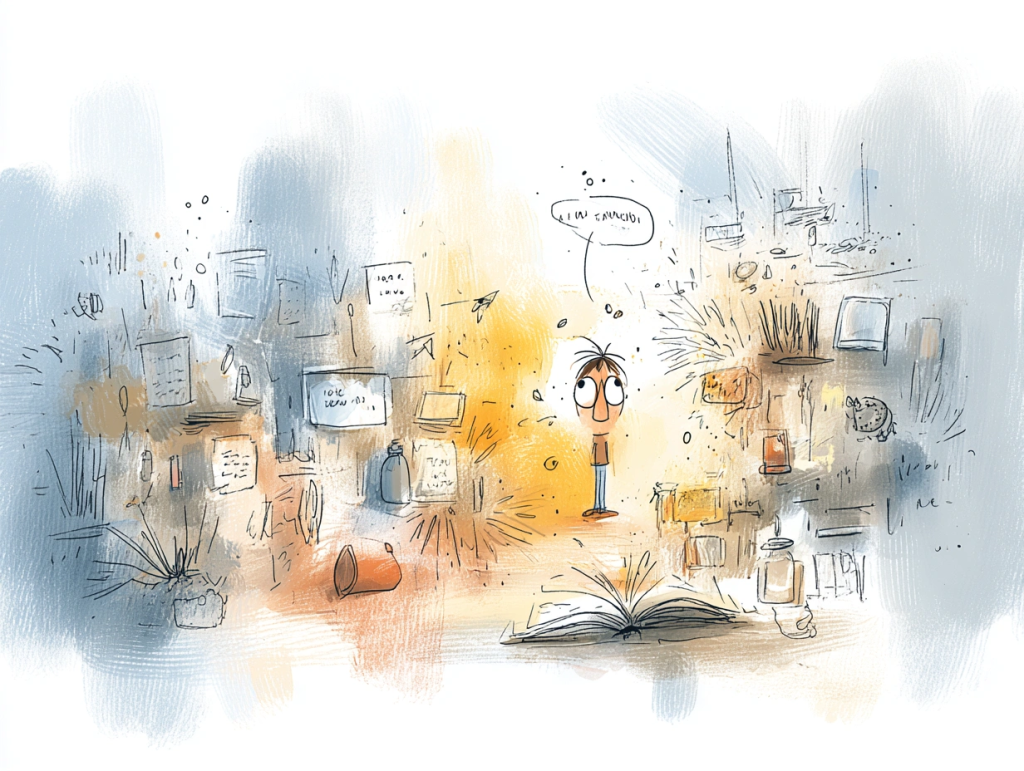
It isn’t about talent, it’s about telling the truth
Art journaling is a personal practice, not a performance.
You’re not trying to impress anyone. You’re not trying to “get better” unless you want to. You’re simply giving your life a page. Some days that page holds a paragraph, other days it holds a smear of paint and one tired sentence. Both count.
Here’s the grounding idea to keep close: it’s not about perfection, it’s about expression.
If you’ve ever thought, “I’m not artistic,” you’re in good company. Most people who love art journaling didn’t start because they had an art background. They started because they needed a place to think and feel without being interrupted by the inner critic.
When you let yourself make marks without judging them, you get access to something useful: your real voice.
Some of my most meaningful pages are messy, layered collages, words scribbled over torn edges, photos taped beside brushstrokes. They’re not pretty, but they’re true. And they take me right back to the version of me who made them.
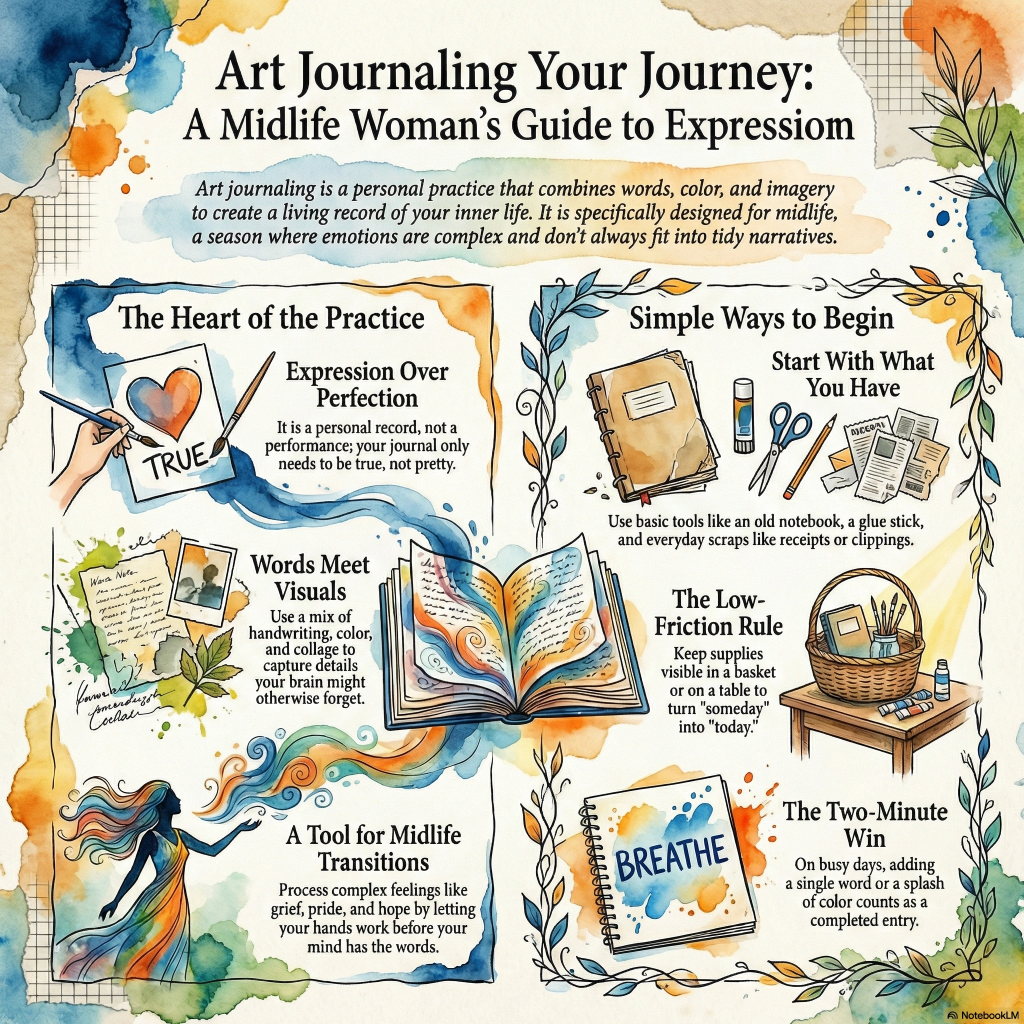
What is art journaling, in plain language?
It’s a journal where you use words plus visuals (color, collage, doodles, photos) to record your life and process what you’re carrying. It’s part diary, part sketchbook, part scrapbook, and it can change day by day.
It’s where words and images meet on the same page
Think of art journaling as a place where clarity and chaos can sit next to each other without arguing.
Some pages will have full sentences. Some will have a single word, circled three times. Some will have a receipt from the day you finally did the hard errand, glued down like proof that you showed up.
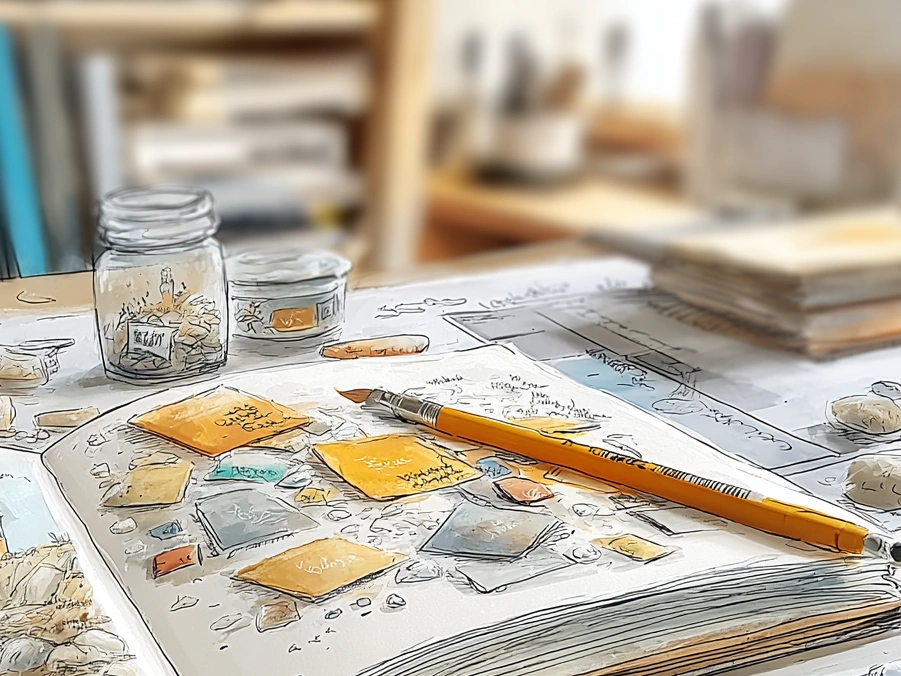
Because art journaling is visual, it holds details your brain might forget later: the color you reached for, the pressure of your pen, the way you covered a mistake with a torn piece of paper and kept going.
It’s also forgiving. You can change your mind mid-page. You can scribble over something, paint over it, or leave it as-is. Your journal can be a living document that matches your actual life, not a highlight reel.
If you’re in a transition (empty nest, divorce, grief, a move, retirement planning, caring for parents), it can help to have a place where you don’t have to explain yourself. You can simply show what’s true, one page at a time.
Why art journaling works so well in midlife
It helps you process feelings without a perfect explanation
Sometimes you know what you feel, but you don’t know what to call it.
Art journaling gives you another route in. Instead of forcing a clean narrative, you can start with an image, a color, a scrap of paper, a shape. You can let your hands begin before your mind has the words.
That matters in midlife, because you’re often holding a lot at once: pride, grief, freedom, worry, hope. Real life rarely arrives in one emotion at a time.
A steady creative practice can help you:
- Explore emotions without needing to explain them
- Capture seasons of your life in color, texture, and words
- Notice patterns in your thoughts and energy
- Build a sense of purpose through personal expression
There’s also something calming about working with your hands. Tearing paper, gluing scraps, making quick marks, these are small actions with a clear beginning and end. When the rest of life feels open-ended, that kind of “finish line” can be a relief.
If you want a research-informed view of why combining images and words can support well-being, see visual journaling and health promotion.
I’ve kept pages that look like a storm hit them, ink, tape, crooked clippings, smudged paint. Later, those pages feel like a time capsule. Not a polished version of life, the real one.
It helps you spot patterns, choices, and what matters now
Art journaling doesn’t just help you vent. It helps you notice.
When you look back through a few weeks of pages, patterns show up. You might see that you always reach for gray when you’ve been overcommitting. Or you might notice you write the word “rest” over and over, even when you keep ignoring it.
That’s information.
You also begin to track what supports you. Maybe your pages get lighter when you spend time outside. Maybe you feel steadier after a phone call with one specific friend. Maybe you’re craving more beauty in your home, more art, more music, more quiet.
This is where art journaling connects to purpose. Not purpose as a grand mission statement, but purpose as daily alignment. The kind that asks, “What am I building now? What am I ready to release?”
And if you’re living solo, there’s a special kind of power in having a practice that belongs only to you. No one else’s opinion gets a vote. You’re allowed to take up space on the page.
Get Your Free Workbook!
Reflect on your life lessons, values, and creative sparks to uncover the purpose that’s been there all along.
Simple ways to begin without buying a bunch of supplies
Your starter kit can come from your house
You don’t need a shopping list. You need a starting point.
If you tend to freeze when something feels like a “project,” this is your permission slip to keep it basic. You can start art journaling with what you already have:
- An old notebook or sketchpad
- A glue stick or tape
- Pens, highlighters, or markers
- Scraps of paper, magazine clippings, receipts, fabric, photos
That’s enough.
If you want to make it even easier, choose one “home base” tool. For example: a black pen and one highlighter. Or a glue stick and a stack of junk mail. Limits can reduce pressure.
Try thinking of your first pages as warm-ups. You’re not creating art for a wall. You’re creating a record of your life as it is.
A single word counts. A burst of color counts. A page of shapes counts.
One of my favorite spreads came from a messy week. I tore out magazine pages without thinking and glued down a quote I’d scribbled on a sticky note. That one page carried me for months.
Set up a routine that’s low-friction, not ambitious
If you’re trying to make this a habit, make it easy to start.
The biggest barrier usually isn’t time. It’s setup. If your supplies are hidden in a closet, you’ll “do it later,” which often becomes not at all.
Here are a few practical options:
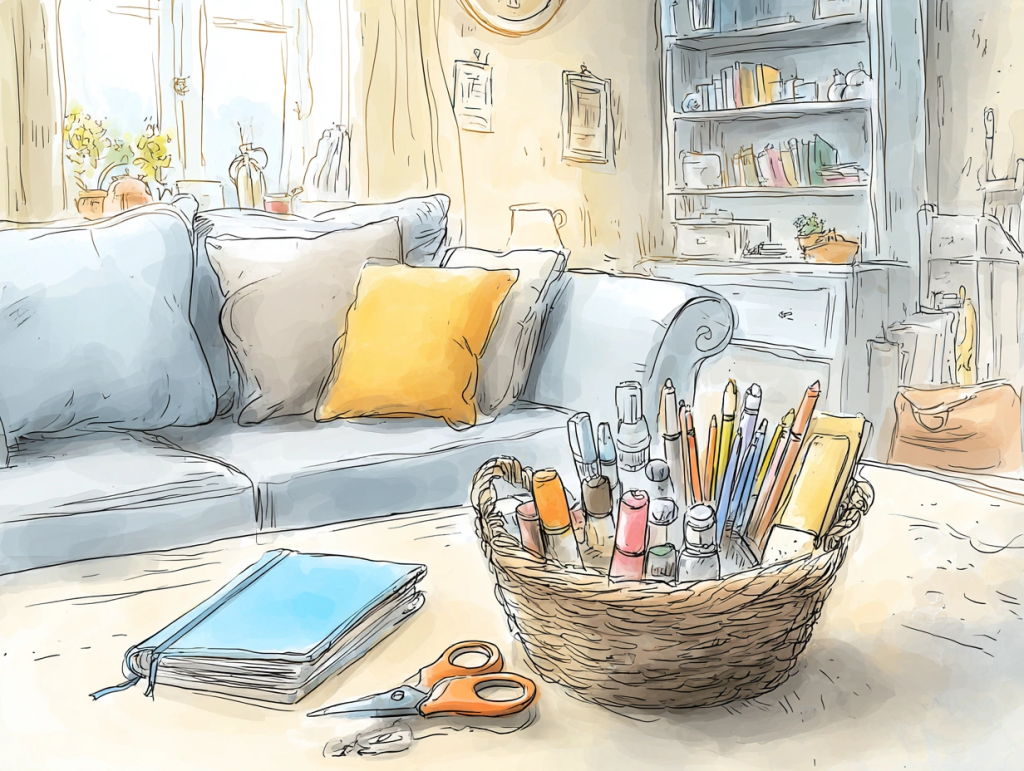
Option 1: The one-basket setup
Keep a small basket with your journal, a pen, and adhesive. That’s it.
Option 2: The coffee table setup
Leave your journal out where you rest at night, paired with your reading glasses or a candle.
Option 3: The two-minute rule
Tell yourself you only have to open the journal and add one thing. A word, a shape, a scrap. If you keep going, great. If not, you still kept the promise.
Art journaling works best when it feels like relief, not another standard you have to meet.
I keep my journal where I can see it: in a small open bin with colored gel pens and a glue stick. When it’s visible, it feels like an open door. When it’s tucked away, it turns into “someday,” and someday gets busy.
Prompts that get you moving when you don’t know what to do
Four prompts you can return to anytime
When you’re not sure where to begin, prompts remove the pressure of inventing something from scratch. Try one of these and keep it simple:
- Collage your week using scraps, photos, or ticket stubs
- Draw your mood using only abstract shapes or colors
- Write one sentence about your day, then decorate around it
- Collect words and images that match a dream or intention
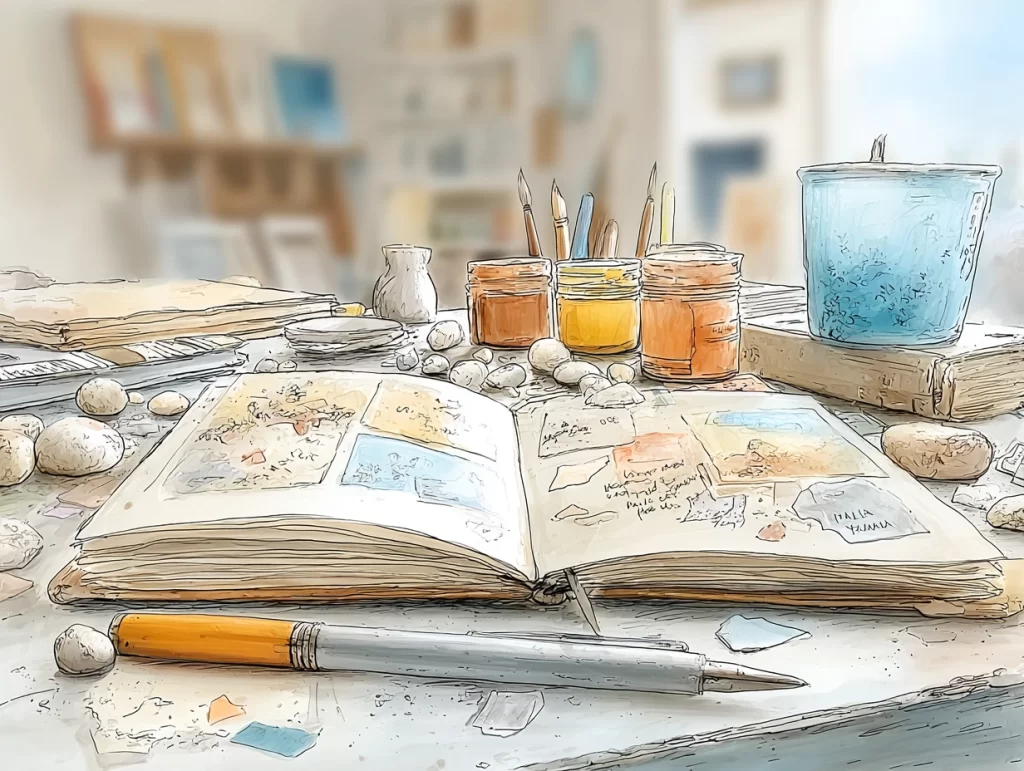
A prompt is just a starting line. You can follow it closely or drift away from it halfway through. Either way, you’re moving.
If you’re an overthinker (many smart women are), collage can be your best friend. Tearing and placing pieces is physical. It interrupts the loop of thoughts and gives your hands a job. You don’t have to solve your life to make a page.
Also, don’t underestimate the power of ordinary artifacts. A receipt. A napkin. A note you wrote to yourself and almost threw away. These small scraps are honest. They hold the real texture of your days.
When the page feels blank, use structure instead of inspiration
Some days you won’t feel inspired. That doesn’t mean you should quit. It means you need a structure that carries you.
Here are a few page “skeletons” you can use on low-energy days:
The three-word page: Write three words that describe today, then add one color behind each.
The border page: Make a messy border with scraps, then write in the middle.
The list page: Write a short list (“What I’m carrying,” “What I need,” “What I’m proud of”) and circle one line to decorate.
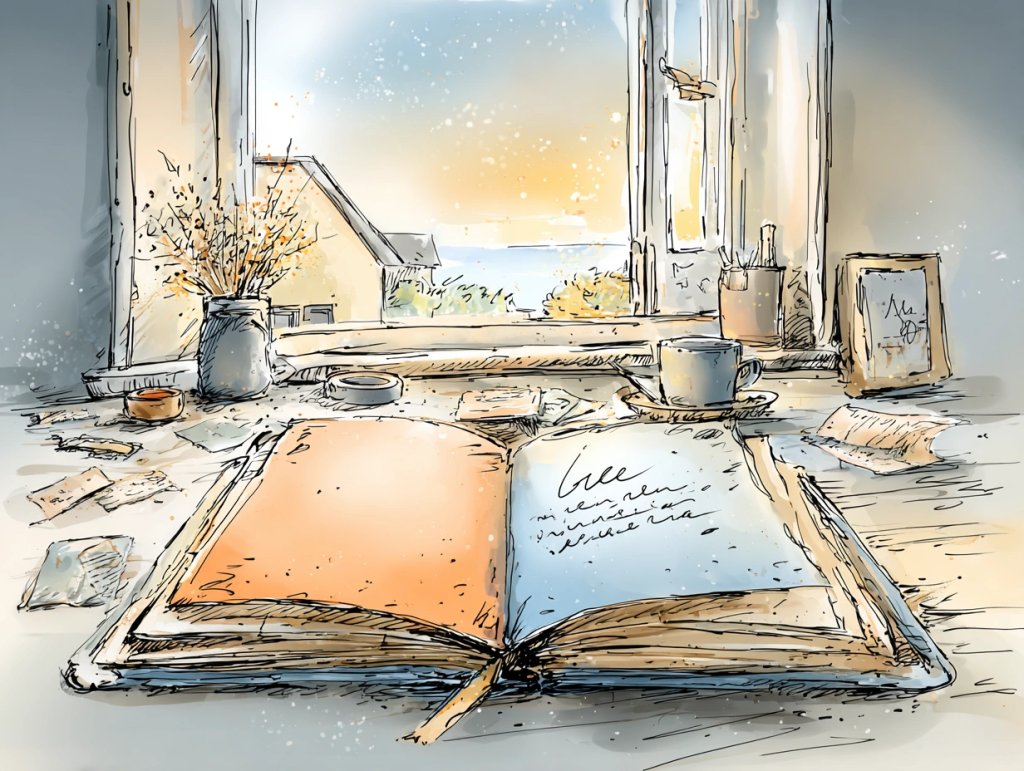
This is the quiet secret of art journaling: you can make it as small as you need. Consistency grows from doable steps, not big moods.
When I first started art journaling, the blank page felt intimidating. One day, while browsing a used bookstore, I found an old copy of The Daring Book for Girls. It became my first art journal. I still return to it sometimes, just to play.
If you’re in a season where your brain is full (work stress, family needs, health appointments), think of your journal as a container. You’re not trying to empty the ocean. You’re giving it a cup.
Making your art journal feel like you (not Pinterest)
You can be organized, chaotic, or both
There are no rules in art journaling, and that’s the point.
Some people love monthly themes. Others bounce from color to chaos and back again. You might have one clean page followed by something that looks like a paper tornado. That’s normal. That’s human.
Try different approaches and notice what helps you feel more like yourself afterward.
- If you feel scattered, a theme can help. One color for the week, one word for the month.
- If you feel boxed in, play helps. Random scraps, messy paint, crooked letters.
- If you feel numb, sensory elements can wake things up. Texture, layering, rubbing pencil over a leaf.
Your journal can change as your season changes. That flexibility is part of why it works.
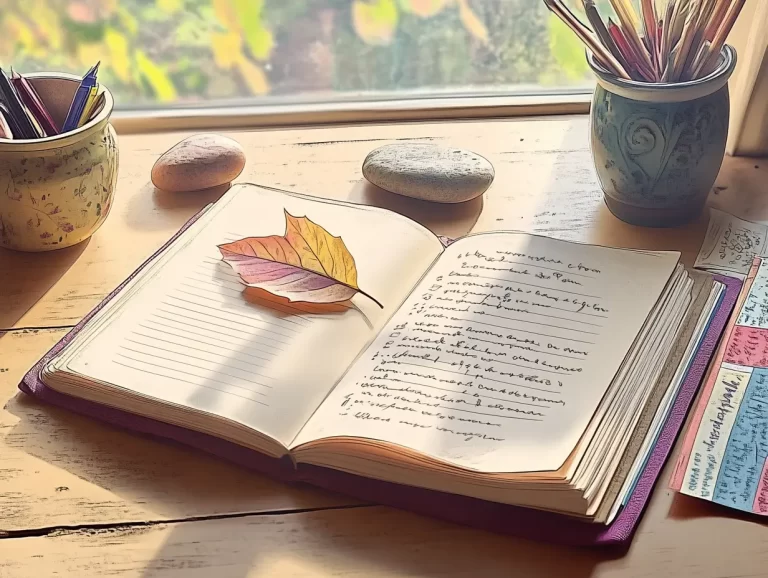
My journals are layered and unruly, bits of paper, taped-in leaves, half-finished doodles, fussy-cut botanicals, and wonky birds. They’re never polished. But they always look like me.
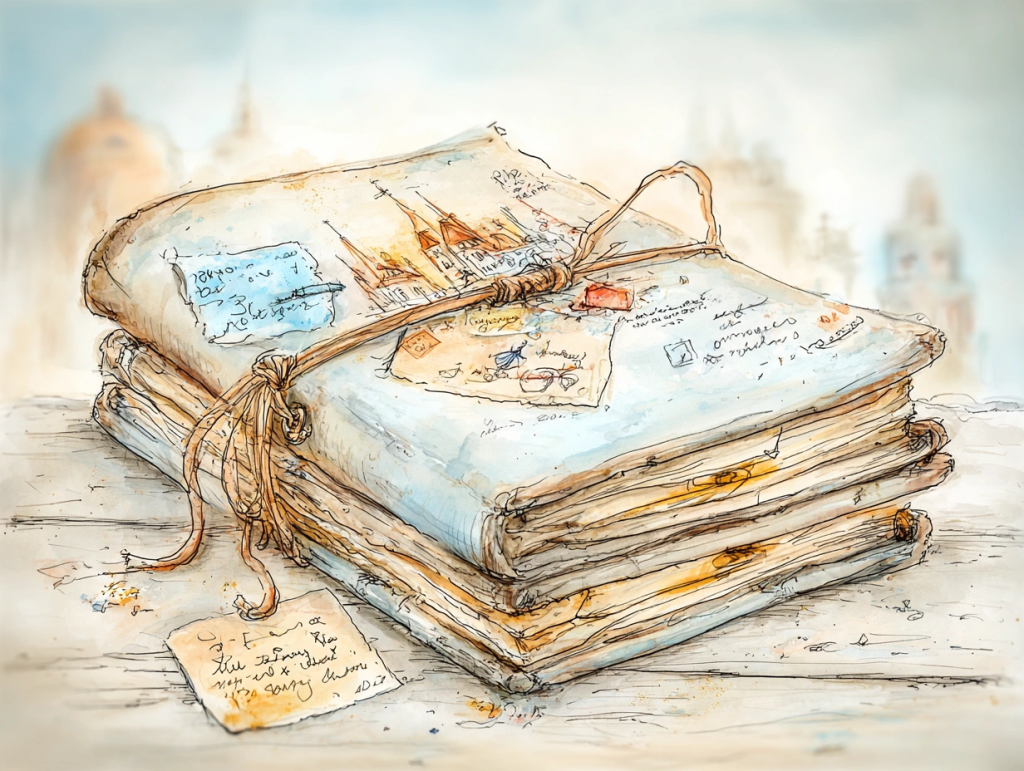
Think of it as a personal museum in motion
An art journal is a personal museum that moves with you.
It holds evidence of who you were, what you lived through, what you cared about, and what you were becoming before you even knew it. A page doesn’t have to be “good” to be valuable. It just has to be yours.
This can be especially steadying in midlife, when so much is shifting. Roles change. Relationships change. Your body may change. Your priorities definitely change.
Your journal becomes a place where you can witness yourself.
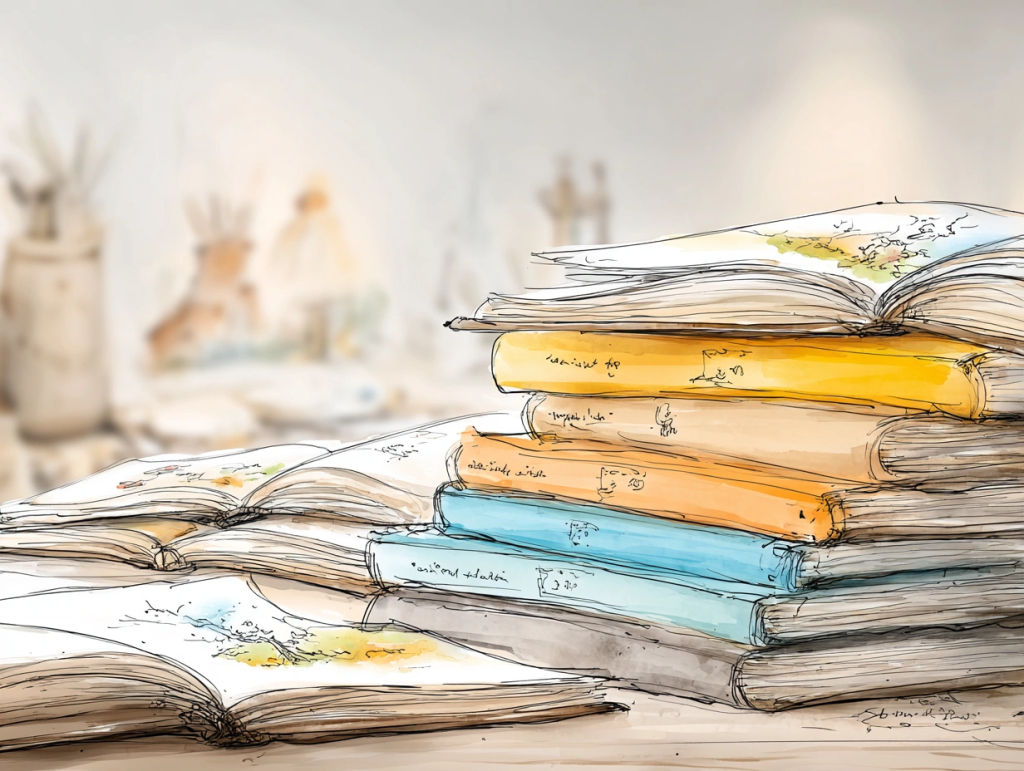
If you’ve been the one who keeps everything running for everyone else, this practice quietly flips the script. You’re no longer only responding to life. You’re recording it. You’re shaping it. You’re giving your inner life a home.
And over time, you’ll build something that’s hard to describe but easy to feel: continuity. A thread.
Key Takeaways
Art journaling is honesty on paper, not an art contest.
Words and images together can say what words alone can’t.
Starting is the win, even if you only add one scrap or one word.
Prompts and page structures help when you feel stuck.
Your journal doesn’t need to look good; it needs to feel true.
3 Ways to Start Today
- Choose a notebook and claim it as your art journal.
- Pick one word and explore it with color, shape, or collage.
- Add one object from your day (a receipt, leaf, quote, or doodle) to your first page.
Your story deserves a canvas
Your story doesn’t need to be tidy.
It doesn’t need to be impressive.
It just needs to be yours.
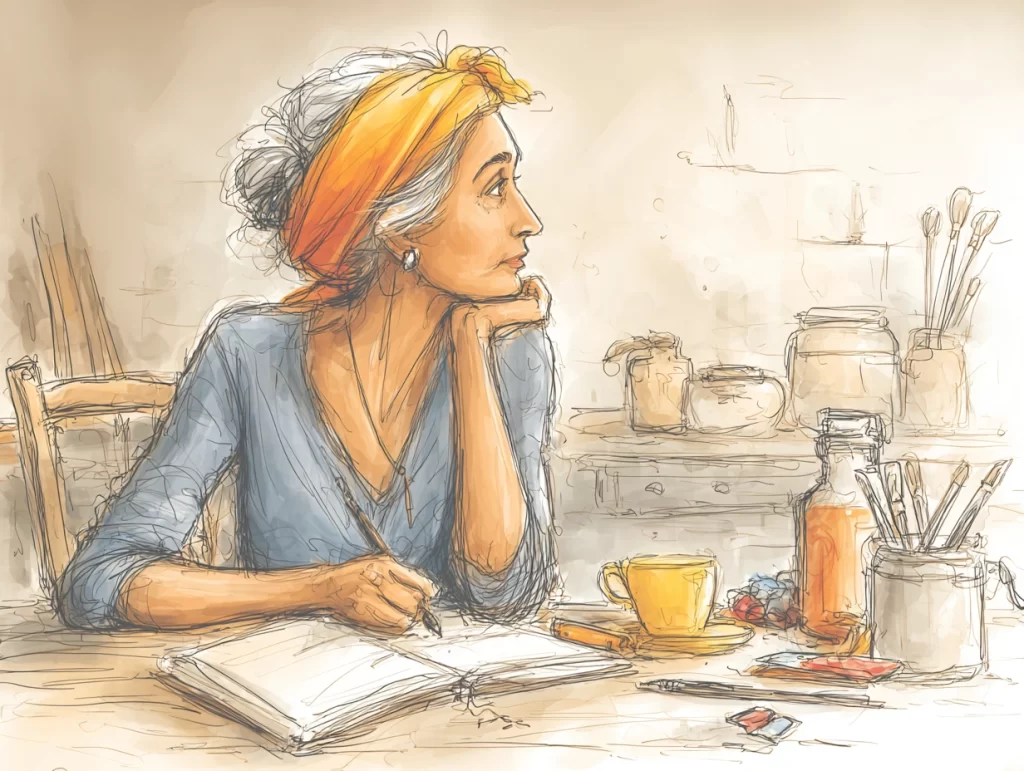
Art journaling gives you a place to weave truth into color and form, to process what’s real, and to record what matters. If you keep showing up, even in small ways, your journal becomes proof that you were here, and that you were listening to your own life.
What matters is that you begin.
So . . .
What might unfold if you gave your inner voice a page to speak freely this week?